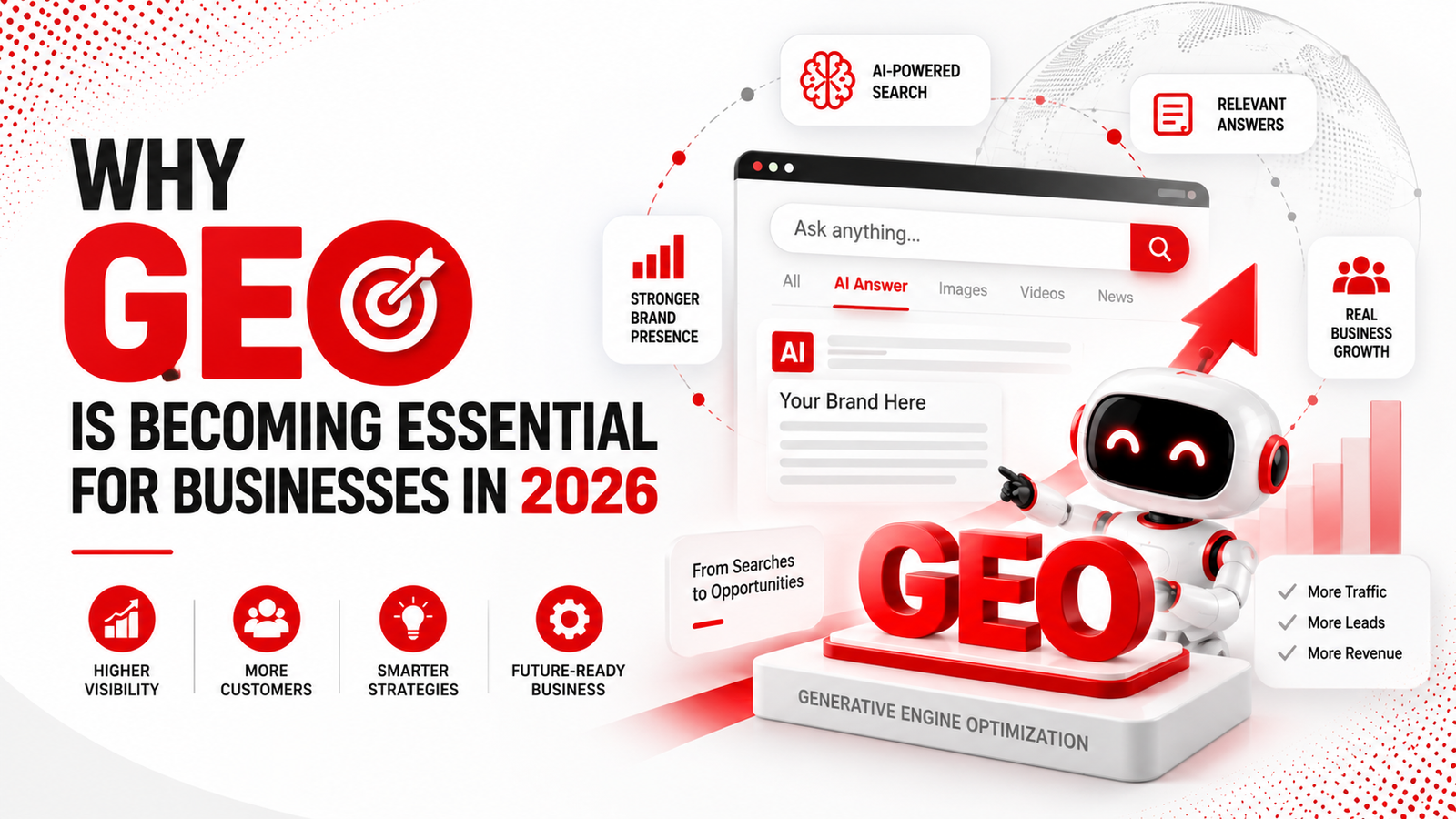
Search is changing faster than ever. People are no longer relying exclusively on traditional search engines to find information, compare products, research services, or make purchasing decisions. Instead, they are increasingly turning to AI-powered platforms that can understand questions, summarize information, compare options, and provide direct answers.
For businesses, this shift creates a new challenge: appearing in the answers generated by AI systems.
This is where GEO is becoming increasingly important. While traditional SEO focuses on improving a website’s visibility in search engine results pages, generative engine optimization focuses on helping brands and their content become more visible and useful within AI-generated responses.
As AI continues to influence how people discover information in 2026, businesses that adapt their search strategies can gain an advantage in visibility, credibility, and customer acquisition.
What Is GEO?
Generative engine optimization is the process of optimizing a brand’s online presence and content so that it has a better opportunity of being discovered, understood, referenced, or represented by generative AI systems.
Traditional search engines generally provide users with a list of links. AI-driven platforms can take a different approach by interpreting a user’s question and generating a response based on information gathered from multiple sources.
This means businesses need to think beyond ranking for individual keywords.
Content should be accurate, useful, well-structured, authoritative, and easy for AI systems to interpret. Clear explanations, trustworthy sources, consistent business information, and strong topical relevance can all contribute to a brand’s ability to appear in AI-generated answers.
The goal is not to replace SEO. Instead, GEO expands the way businesses think about search visibility in an environment where users may receive an answer before they ever click a traditional search result.
Why AI Search Is Changing Customer Behaviour
The growth of AI search is changing how people interact with information online. Instead of entering several short searches and opening multiple websites, users can ask increasingly detailed questions and receive conversational responses.
For example, someone looking for accounting software may previously have searched for “best accounting software” and reviewed several pages. With ai powered search, that person might ask which accounting software is best for a small business, compare specific features, and request recommendations based on their budget.
This creates new opportunities for brands to become part of the research process.
Businesses need to understand how their customers ask questions, what information they need before making a decision, and which topics their brand should be associated with. This is one reason geo optimization is becoming a valuable part of modern digital marketing strategies.
Rather than creating content only around high-volume keywords, businesses should build comprehensive resources that answer the questions customers are likely to ask throughout the buying journey.
The Growing Importance of AI Search Visibility
One of the biggest reasons businesses are investing in new search strategies is AI search visibility.
Being visible on Google remains important, but the search landscape now includes platforms that generate answers instead of simply displaying ranked webpages. As these systems become more common, businesses need to consider whether their content can be understood and potentially referenced by AI.
Strong AI search optimization involves more than inserting keywords into content. It requires businesses to create information that clearly demonstrates expertise and answers specific user questions.
For example, a healthcare business could create detailed resources explaining common procedures, preparation requirements, benefits, risks, and frequently asked questions. A software company could publish practical guides, feature comparisons, tutorials, and use cases.
The more useful and authoritative the content is, the more opportunities there may be for the business to become relevant to AI-generated answers.
AI Search Engines Are Creating a New Visibility Layer
The rise of AI search engines is creating another layer between businesses and their potential customers.
Platforms such as ChatGPT, Google’s AI-powered search experiences, Microsoft Copilot, and other emerging systems can influence what information users see when researching a topic.
This does not necessarily mean traditional search is disappearing. Instead, businesses now have multiple discovery environments to consider.
A successful strategy should therefore account for both conventional search results and AI-generated responses. Businesses that continue to rely exclusively on traditional rankings could miss opportunities to reach users who increasingly begin their research through conversational AI.
This is where GEO can complement traditional SEO by preparing content for a broader search ecosystem.
GEO vs SEO: What’s the Difference?
The discussion around geo vs seo is often framed as if businesses need to choose one strategy over the other. In reality, the two approaches can work together.
SEO focuses heavily on improving a website’s ability to rank in traditional search results. It includes areas such as keyword targeting, technical optimization, internal linking, backlinks, content quality, and user experience.
GEO, on the other hand, considers how information can be surfaced within generative AI responses.
There is considerable overlap between the two. High-quality content, strong authority, clear website architecture, accurate information, and a positive online reputation can support both strategies.
The difference is largely in the way businesses think about visibility.
SEO asks:
How can we improve our position in search results?
GEO asks:
How can we make our brand and information useful and discoverable within AI-generated answers?
Businesses that combine both perspectives can build a more resilient search strategy.
Using AI for SEO and GEO
AI is not only changing search; it is also changing how marketers approach optimization. Using AI for SEO can help teams identify content opportunities, analyze search intent, organize information, generate content ideas, and identify gaps in existing resources.
However, AI-generated content should not simply be published without review.
Businesses still need human expertise, fact-checking, originality, and editorial judgment. AI can accelerate research and content workflows, but useful content must ultimately provide genuine value to the audience.
The same principle applies to GEO. Businesses should not attempt to manipulate AI systems with repetitive keywords or artificial content. Instead, they should focus on becoming a reliable source of information.
This means creating content that answers real questions, demonstrates experience, uses accurate information, and provides enough context for both users and AI systems to understand the subject.
What Businesses Should Do to Improve AI Visibility
Businesses can take several practical steps to improve their presence across traditional and AI-driven search.
1. Create Comprehensive, Helpful Content
Instead of publishing short articles targeting individual keywords, build resources that comprehensively cover important topics.
Answer related questions, explain concepts clearly, include examples, and address common concerns. This gives AI systems more useful information to work with.
2. Demonstrate Expertise and Authority
Trust matters in traditional search and becomes even more important when AI systems are selecting information to include in an answer.
Clearly communicate who created the content, demonstrate relevant expertise, support claims with reliable information, and keep important business details accurate.
3. Optimize for Conversational Questions
Users often interact with AI using complete questions rather than short keyword phrases.
Content should therefore address natural-language queries such as:
- What is the best solution for a small business?
- How does this service work?
- What should I consider before choosing a provider?
- What are the benefits and limitations?
- How much does this service typically cost?
This approach can help businesses align their content with the way people interact with AI.
4. Strengthen Your Overall Digital Presence
AI systems may consider information from multiple sources when generating responses. Businesses should therefore maintain consistent information across their website, business profiles, industry publications, directories, and other reputable online sources.
A strong digital footprint can help reinforce brand identity and authority.
AI Search Results Can Influence the Buying Journey
Another important consideration is the growing influence of AI search results on purchasing decisions.
A potential customer may ask an AI platform to recommend several companies, compare products, explain differences between services, or identify the best option for a specific need.
If a business is absent from these conversations, competitors may gain visibility instead.
This is particularly important for competitive industries where customers conduct extensive research before contacting a company.
GEO gives businesses a framework for thinking about how their expertise, content, brand information, and reputation can contribute to these AI-driven discovery journeys.
Why 2026 Is a Critical Year for GEO
The future of SEO is unlikely to be about abandoning traditional optimization. Instead, it will involve adapting to a more complex search ecosystem.
Search engines will continue to evolve, while generative AI will increasingly influence how information is discovered and consumed. As a result, businesses will need to consider multiple ways customers can encounter their brand.
These developments are also shaping future SEO trends, including conversational search, AI-generated answers, entity-based optimization, topical authority, structured content, and greater emphasis on brand credibility.
Businesses that begin adapting now can learn how AI platforms interpret their industry, identify the questions their customers are asking, and develop content that provides genuinely useful answers.
How to Build a GEO Strategy for Your Business
A practical GEO strategy should begin with understanding the questions your target audience asks.
Start by identifying important topics, customer pain points, comparison queries, and informational searches related to your products or services. Then evaluate whether your existing website provides clear and authoritative answers.
Next, identify content gaps and develop resources that address them comprehensively.
Businesses should also review their technical SEO foundations, internal linking, structured data, author information, business details, and external mentions. While there is no single formula that guarantees inclusion in an AI-generated response, strong fundamentals can make a brand’s information easier to understand and validate.
Most importantly, businesses should treat GEO as an ongoing strategy rather than a one-time optimization project.
AI platforms and search experiences will continue to change. Customer behaviour will change with them. Regularly reviewing content performance, search behaviour, brand visibility, and emerging AI search features will help businesses remain adaptable.
The Future Belongs to Businesses That Adapt
Search is becoming more conversational, personalized, and AI-driven. For businesses, this means visibility can no longer be viewed solely through the lens of traditional rankings.
GEO provides a way to think about visibility in this evolving environment. By creating authoritative content, answering real customer questions, strengthening their digital presence, and maintaining strong SEO foundations, businesses can prepare for a search landscape where AI-generated answers play an increasingly important role.
The businesses that act early can build valuable authority before AI-driven search becomes even more competitive.
In 2026, the question is no longer simply whether your website can rank.
It is whether your brand can become a trusted source when customers ask AI for the answer.
Prepare Your Business for the Future of Search
AI is changing how people discover information, evaluate businesses, and make decisions online. Building a strong search strategy now can help your business adapt as traditional and AI-driven search continue to evolve.
At SEO Rank1, we combine data-driven SEO strategies, keyword research, technical audits, content optimization, and ongoing performance tracking to help businesses strengthen their online visibility. Our approach is tailored to each business, industry, and audience rather than relying on a one-size-fits-all strategy.
Ready to improve your search visibility and prepare your website for the next generation of search?
Get your free SEO audit today and discover opportunities to strengthen your online presence.
Get a Free SEO Audit with SEO Rank1
FAQs
What is GEO?
GEO is the process of improving a brand’s content and online presence so it can be more easily understood, discovered, and potentially referenced by AI-powered search platforms. It focuses on creating authoritative, useful, and well-structured content that answers the questions users ask conversationally.
Why is GEO important for businesses in 2026?
GEO is becoming important because customers are increasingly using AI-powered search to research products, services, and businesses. As AI-generated answers become a larger part of the search experience, businesses need to consider how their brand and content can appear in these new discovery environments.
How is GEO different from traditional SEO?
Traditional SEO primarily focuses on improving visibility in conventional search engine results, while GEO focuses on visibility within AI-generated responses. However, they share many important foundations, including high-quality content, technical optimization, authority, relevance, and a strong user experience. Businesses can use both approaches as part of a broader search strategy.
Does GEO replace SEO?
No. GEO should complement, rather than replace, traditional SEO. Search engines and AI platforms can work differently, but strong SEO fundamentals can still help search engines and AI systems understand a website, its content, and its areas of expertise.
How can a business start with GEO?
Businesses can start by identifying the questions their target audience asks, creating comprehensive content that answers those questions, demonstrating subject-matter expertise, maintaining accurate business information, and strengthening their overall online presence. Reviewing existing content for clarity, authority, and topical depth is also a useful starting point.
Can GEO improve brand visibility?
It can support broader brand visibility by helping businesses create content that addresses the topics and questions associated with their products or services. As users increasingly rely on AI-generated answers during research, being recognized as a relevant and trustworthy source can become an important part of a brand’s digital strategy.
Is GEO only useful for large businesses?
No. Businesses of different sizes can benefit from preparing their content for AI-driven search. Smaller businesses can particularly benefit from developing strong topical authority around their niche, answering specific customer questions, and creating useful resources that demonstrate their expertise.