You built a website. You invested in the design, added your services, published content, and maybe even started getting visitors.
But there is one problem:
The leads aren’t coming in.
Your website may look professional, but if visitors aren’t filling out forms, calling your business, booking consultations, requesting quotes, or making purchases, something isn’t working.
So, why is my website not generating leads?
If you’re wondering how to generate leads from website traffic, the answer is rarely just one problem. Your website might not be attracting the right audience, your content may not match search intent, your pages may not rank for valuable keywords, or visitors may simply have no clear reason to take the next step.
This is where SEO becomes more than a strategy for increasing rankings. Understanding how to generate leads from website visitors means using SEO to attract the right people, answer their questions, build trust, and guide them toward conversion.
If you’re wondering how to generate leads from website traffic, the first step isn’t necessarily getting more traffic. It’s understanding whether you’re attracting the right people and whether your website gives them a clear path to becoming a lead.
In this guide, we’ll look at the most common reasons websites fail to generate leads and how SEO can help solve each problem.
Why Is My Website Not Generating Leads?
If your website isn’t producing leads, it’s tempting to assume you simply need more visitors.
But traffic alone doesn’t guarantee results.
You could receive thousands of visitors every month and still generate very few leads if those visitors aren’t interested in what you sell.
For example, imagine a B2B company receives 10,000 monthly visitors but most of them are looking for free information rather than a service provider. Increasing traffic to 20,000 visitors won’t necessarily double the number of leads.
The better question is:
Are the right people finding your website, and does the website convince them to take action?
There are several reasons a website may struggle:
- It doesn’t rank for the right keywords.
- It attracts visitors with low purchase intent.
- Its content doesn’t answer customer questions.
- Visitors don’t understand what the business offers.
- Calls to action are unclear.
- Landing pages aren’t optimized for conversions.
- The website lacks trust signals.
- Pages are difficult to navigate.
- Technical SEO problems limit visibility.
- The website doesn’t provide a clear next step.
Understanding these problems is essential if you want to know how to generate leads from website visitors instead of simply increasing traffic numbers.
1. You’re Getting Traffic From the Wrong Audience
One of the biggest misconceptions in digital marketing is that more traffic automatically means more leads.
It doesn’t.
The quality and relevance of your traffic matter just as much as the quantity.
A website selling enterprise software, for example, doesn’t necessarily benefit from attracting thousands of visitors searching for free software tools. Similarly, a local service business won’t generate many customers from visitors searching for general information outside its service area.
This is where search intent SEO becomes important.
Search intent refers to the reason behind a user’s search. Someone searching for:
“What is SEO?”
has a very different intent from someone searching for:
“SEO agency for SaaS companies”
The second search suggests a much stronger commercial intent.
Your SEO strategy should therefore target the searches your potential customers make at different stages of the buying journey.
Informational content can introduce your brand to potential customers, while commercial and transactional pages can target users who are closer to making a decision.
This alignment between audience, keyword, content, and business goal is a critical part of SEO and lead generation.
If you’re trying to figure out how to generate leads from website traffic, start by asking whether your visitors actually represent your ideal customers.
2. Your Website Isn’t Ranking for Valuable Keywords
Another common reason websites don’t generate leads is simple:
Potential customers aren’t finding them.
If your website is not ranking on Google for the keywords your target audience uses, your lead generation potential will be limited.
You might have an excellent service and a beautiful website, but if your competitors appear when customers search for solutions you provide, those customers may never discover you.
This is why SEO lead generation starts with keyword research.
Instead of targeting keywords based solely on search volume, businesses should consider:
- Relevance to their services
- Search intent
- Commercial value
- Competition
- Customer pain points
- Buying stage
- Geographic relevance
For example, a keyword with 500 monthly searches and strong commercial intent may be more valuable than a keyword with 10,000 searches from users who have no intention of buying.
Effective SEO lead generation focuses on attracting visitors who are likely to become customers.
That means your strategy should prioritize the searches that connect directly to your products, services, and solutions.
If you’re researching how to generate leads from website visitors, ranking for the right keywords is one of the first things to evaluate.
3. Your Content Doesn’t Match Search Intent
Getting someone to your website is only the beginning.
If your page doesn’t provide what the visitor expected, they may leave without taking action.
This is another reason search intent SEO should be part of your content strategy.
Imagine someone searches:
“Best SEO agency for eCommerce”
and lands on a page that only explains what SEO is.
The page may technically be relevant to SEO, but it doesn’t satisfy the user’s actual intent.
Instead, the visitor probably wants information about:
- eCommerce SEO services
- Agency experience
- Results and case studies
- Pricing or packages
- Areas of expertise
- Client results
- How the agency works
- Why they should choose one agency over another
Content should therefore be created around the questions and decisions your audience is actually trying to solve.
This is also where website lead generation and SEO intersect.
Content should not exist simply to attract clicks. It should move potential customers closer to taking action.
When you understand what users want at each stage of the journey, it becomes much easier to determine how to generate leads from website visitors through relevant content.
4. Your Website Is Getting Traffic but Not Converting
Perhaps you’re already ranking.
Your analytics show organic traffic.
People are visiting your pages.
But they’re leaving without contacting you.
This is the classic problem of website traffic not converting.
In this situation, more SEO traffic isn’t necessarily the immediate solution.
You need to investigate what happens after visitors arrive.
Look at:
- Landing pages
- Bounce and engagement patterns
- Calls to action
- Contact forms
- Page structure
- Navigation
- Messaging
- Trust signals
- Mobile experience
- Page speed
- Conversion paths
A website can attract the right visitors and still fail because the experience doesn’t persuade them to take the next step. This is where website conversion optimization becomes important.
SEO gets the visitor through the door. Conversion optimization helps give that visitor a reason to stay and act.
This is where Search Experience Optimization (SXO) becomes important. By combining SEO with user experience and conversion-focused improvements, businesses can create a website that not only attracts visitors but also makes it easier for them to take action. Learn more about Search Experience Optimization (SXO): Blending SEO and UX for Better Conversions and how SEO and UX can work together to improve conversions.
If you’re trying to understand how to generate leads from website traffic, you need to consider both sides of the equation.
Traffic without conversion = missed opportunity.
5. Your Website Doesn’t Clearly Explain What You Offer
A visitor should be able to understand three things quickly:
What do you do?
Who do you help?
What should I do next?
If your homepage uses vague messaging such as “Transforming businesses through innovation” without explaining what the company actually provides, visitors may struggle to understand whether the business can solve their problem.
Clarity matters.
Your website should communicate:
- Your core service
- Your target audience
- The problem you solve
- Your unique value
- Why customers should trust you
- The next action they should take
This can have a significant impact on your website conversion rate.
A clear message reduces friction and helps visitors determine whether your business is relevant to them.
It’s also an important part of understanding how to get leads from website traffic.
Visitors don’t become leads simply because a contact form exists. They need to understand why contacting your business is worthwhile.
6. Your Calls to Action Aren’t Strong Enough
Even when visitors are interested, they may not know what to do next.
A website can have excellent content and strong SEO but still lose potential customers because its calls to action are unclear.
Compare:
“Submit”
with:
“Book Your Free SEO Consultation”
The second option communicates what happens next and why the visitor should click.
Your calls to action should match the user’s stage in the buying journey.
For example:
Early-stage visitor:
- Read the guide
- Learn more
- View our services
Consideration-stage visitor:
- See our case studies
- Compare solutions
- View pricing
High-intent visitor:
- Request a quote
- Book a consultation
- Contact our team
This connection between content, intent, and action is an important part of website lead generation.
It’s also one of the practical ways businesses can improve how to generate leads from website traffic without necessarily increasing their traffic volume.
7. Your Website Doesn’t Build Enough Trust
People don’t usually submit their information to a business they don’t trust.
This becomes especially important for services that involve significant financial investment or long-term commitments. If you’re learning how to generate leads from website traffic, building trust should be a key part of the visitor’s journey toward conversion.
Your website should provide evidence that your business can deliver what it promises.
Useful trust signals can include:
- Client testimonials
- Case studies
- Reviews
- Certifications
- Industry experience
- Expert authors
- Original research
- Results and data
- Client logos
- Clear company information
- Transparent contact details
Trust can directly influence your website conversion rate because visitors need confidence before taking action.
It also connects SEO with broader business credibility.
Good SEO for lead generation isn’t only about keywords and rankings. Strong content can demonstrate expertise while helping potential customers understand why your business is qualified to solve their problem.
If your goal is understanding how to generate leads from website visitors, don’t overlook the trust layer.
8. Your Website Has Technical SEO Problems
Sometimes the problem isn’t your content or conversion strategy.
It may be technical.
Technical SEO problems can prevent search engines from properly crawling, understanding, or indexing your website.
Common issues include:
- Slow page speed
- Poor mobile usability
- Broken links
- Incorrect redirects
- Indexing problems
- Duplicate content
- Poor site architecture
- Missing or incorrect canonical tags
- Weak internal linking
- Poorly optimized metadata
- JavaScript rendering issues
A technical SEO audit can help identify these problems.
The purpose isn’t simply to produce a long list of technical errors. The goal is to identify issues that may be preventing search engines from accessing important pages or preventing users from having a good experience.
Fixing these issues can strengthen organic visibility and support SEO for lead generation.
And if you’re asking how to generate leads from website visitors, technical performance matters because search visibility and user experience are connected.
9. You’re Not Creating Content Around the Customer Journey
Some businesses publish blogs regularly but still generate few leads.
Why?
Because their content strategy is disconnected from their services.
For example, an accounting firm might publish dozens of articles about general financial concepts but never create content targeting users searching for its actual services. If you’re learning how to generate leads from website traffic, your content should be connected to the questions, needs, and decisions your potential customers have throughout their buying journey.
A strong content strategy should cover multiple stages:
Awareness
Answer questions and educate potential customers.
Consideration
Help visitors compare approaches, providers, and solutions.
Decision
Address objections, explain services, demonstrate results, and provide strong calls to action.
This creates a path from search query to conversion.
The objective isn’t to publish as much content as possible.
It’s to publish the right content for the right audience at the right stage.
This is one of the foundations of SEO lead generation and an important part of SEO and lead generation.
When content is connected to the customer journey, businesses have more opportunities to show visitors how to generate leads from website traffic through strategically designed pages and conversion paths.
10. You’re Ignoring Local Search
For businesses that serve specific geographic areas, traditional organic SEO alone may not be enough.
If your customers search for services near them, local SEO lead generation can become an important part of your strategy. If you’re considering how to generate leads from website traffic, targeting location-specific searches can help you reach potential customers who are actively looking for your services.
For example:
“SEO agency in Riyadh”
has a very different commercial value for a Saudi SEO agency than:
“What is SEO?”
Local SEO can involve:
- Google Business Profile optimization
- Local keyword targeting
- Location pages
- Reviews
- Local citations
- Consistent business information
- Locally relevant content
- Location-specific service pages
The objective is to appear when customers in your target market are actively looking for your services.
This can make local SEO lead generation particularly valuable for businesses that depend on local customers.
It can also support SEO for business growth by connecting your website with high-intent searches in the locations you serve. For businesses targeting specific markets, knowing how to generate leads from website traffic means making sure your website is visible for the local searches that matter most.
How SEO Actually Helps Generate Leads
SEO is often presented as a traffic-generation strategy.
But its business value goes further.
A strong SEO strategy can influence the entire journey:
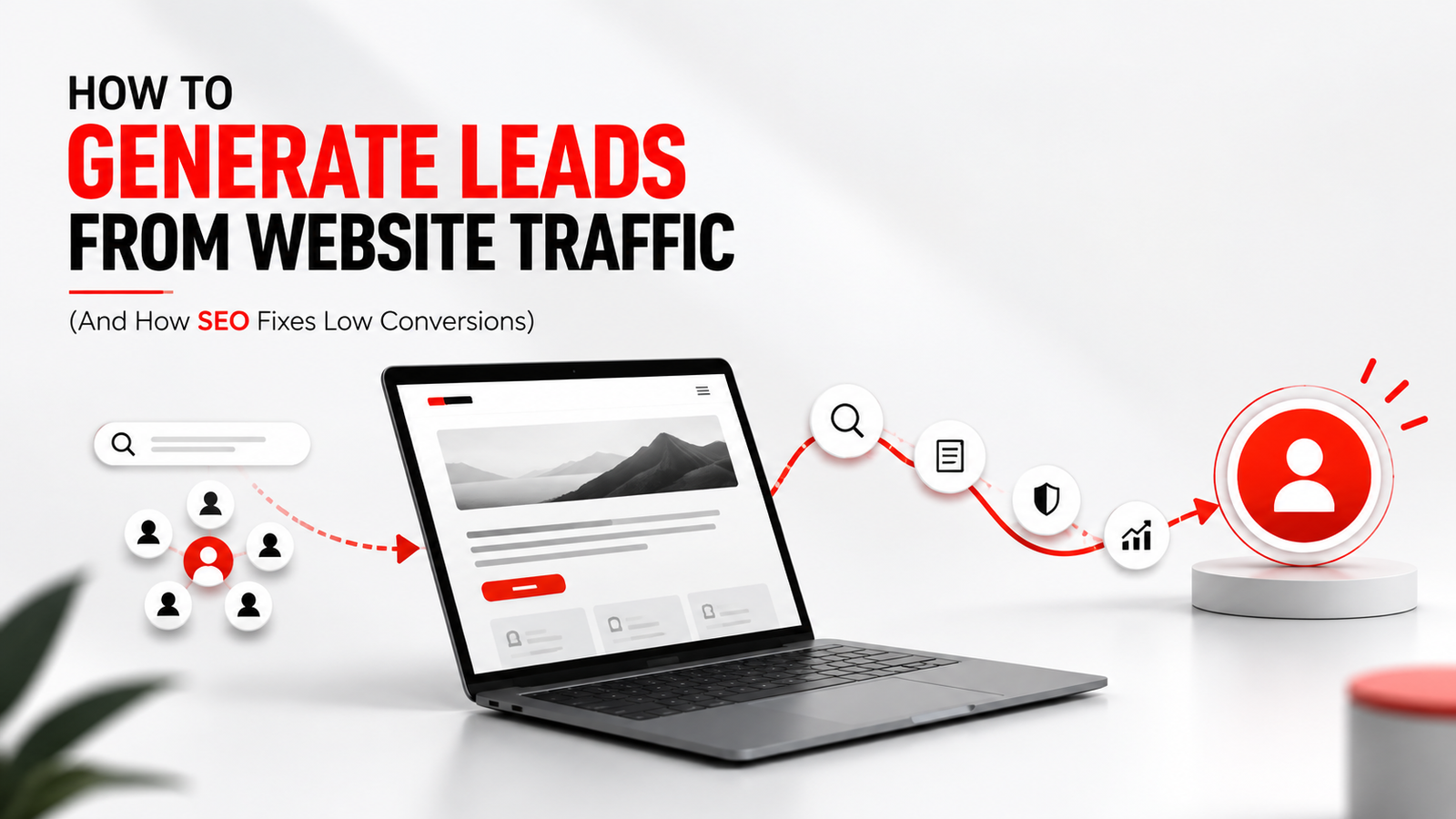
Search → Discovery → Education → Trust → Consideration → Conversion
Here’s how.
SEO increases qualified visibility
By targeting relevant keywords, SEO helps your business appear in front of people actively searching for information, products, or services related to your business.
SEO aligns content with customer needs
Content built around search intent can answer questions and address problems before a visitor ever contacts your sales team.
SEO builds authority
Consistently publishing useful, accurate, expert-led content can help establish your business as a credible source.
SEO creates conversion opportunities
Service pages, landing pages, comparison content, case studies, and commercial articles can target users closer to making a decision.
SEO supports long-term growth
Unlike channels that stop generating traffic when you stop spending, well-optimized organic content can continue attracting relevant visitors over time.
This is why SEO for business growth is about more than rankings.
The real goal is to create a search ecosystem that consistently attracts qualified prospects and moves them toward becoming customers.
How to Generate Leads From Website Traffic: A Practical Framework
If you’re still asking how to generate leads from website traffic, use this framework to identify where your current strategy is breaking down.
Step 1: Identify your ideal customer
Define who you actually want to attract.
Consider their:
- Industry
- Job role
- Location
- Problems
- Goals
- Buying motivations
- Common objections
Step 2: Map their search behavior
Find the questions and keywords they use throughout the buying journey.
Separate informational searches from commercial and transactional searches.
Step 3: Audit your existing traffic
Look at which pages generate organic traffic and whether those visitors match your target audience. If your website traffic is not converting, examine which sources and landing pages are responsible. Understanding how to generate leads from website traffic starts with identifying which pages attract qualified visitors and which ones fail to drive action.
Step 4: Find content gaps
Identify important questions your existing website doesn’t answer.
Then create useful content that addresses those gaps.
Step 5: Optimize your service pages
Your service pages should clearly communicate:
- What you offer
- Who it’s for
- Benefits
- Process
- Proof
- FAQs
- Calls to action
If you’re learning how to generate leads from website traffic, well-optimized service pages can help turn visitors who are actively looking for your solutions into potential customers.
Step 6: Improve conversion paths
Make it easy for visitors to move from information to action. Use relevant internal links, clear CTAs, simple forms, and logical navigation. A clear conversion path is an essential part of how to generate leads from website visitors because it gives qualified prospects an obvious next step.
Step 7: Fix technical issues
Run a technical SEO audit and prioritize problems that affect crawling, indexing, performance, usability, or conversions.
Step 8: Measure leads, not just traffic
Track:
- Form submissions
- Calls
- Consultation bookings
- Quote requests
- Sales-qualified leads
- Conversion rates
- Organic conversions
This gives you a much clearer picture of how to generate leads from website traffic effectively.
SEO Conversion Optimization: Turning Visibility Into Results
Getting someone to your website is only half the job.
The next challenge is converting that visitor.
SEO conversion optimization combines search visibility with conversion-focused improvements.
For example, you might discover that one service page receives thousands of organic visitors but generates very few leads.
Instead of immediately trying to increase traffic, test improvements such as:
- A clearer headline
- Stronger value proposition
- Better CTA placement
- Shorter forms
- More customer proof
- Better page structure
- Stronger internal links
- More relevant supporting content
The objective is to increase website conversion rate by making the experience more relevant and persuasive.
This approach is often more efficient than focusing exclusively on traffic growth.
If your website already attracts qualified visitors, improving the conversion path can help you generate more value from the traffic you already have.
That’s an important part of how to generate leads from website visitors without relying solely on increasing traffic.
How to Improve Website Conversion Rate With SEO
SEO and conversion optimization should not operate as completely separate strategies.
When you improve website conversion rate, you should consider where the visitors came from and what they expected to find. Understanding how to generate leads from website traffic starts with making sure the experience after the click matches the visitor’s intent.
For example, if a visitor searches for:
“enterprise SEO services”
and lands on a page specifically about enterprise SEO, the page should immediately reinforce that intent.
The visitor shouldn’t have to search through your website to understand whether you offer the service.
This is where keyword targeting, search intent, page relevance, messaging, and conversion design come together.
Businesses looking to increase website conversion rate should therefore examine both sides of the process:
Are we attracting the right visitors?
and:
Are we giving those visitors a compelling reason to convert?
By focusing on how to generate leads from website traffic as well as how to attract it, businesses can create a stronger foundation for sustainable website conversion optimization.
SEO and Lead Generation Should Work Together
SEO should not exist in isolation from your wider marketing strategy.
The most effective approach connects organic search with content, branding, user experience, sales, and conversion optimization.
Think of the process as:
SEO → Qualified Traffic → Relevant Content → Trust → Conversion → Lead
Every stage matters.
If SEO brings irrelevant traffic, the process breaks.
If the content doesn’t match intent, the process breaks.
If the website doesn’t build trust, the process breaks.
If there is no clear CTA, the process breaks.
That’s why SEO and lead generation should be viewed as one connected process rather than two separate marketing activities.
The goal isn’t simply to rank.
The goal is to turn search visibility into measurable business outcomes.
The Real Answer to “Why Isn’t My Website Getting Leads?”
If your website isn’t generating leads, don’t immediately assume that you need more traffic.
First, diagnose the problem.
Ask:
Are the right people finding my website?
Am I ranking for high-intent keywords?
Does my content match search intent?
Is my website clearly communicating its value?
Are visitors able to trust my business?
Are my calls to action clear?
Is my website technically healthy?
Are my landing pages optimized for conversion?
Am I tracking leads rather than just traffic?
These questions can reveal whether the problem is visibility, relevance, trust, user experience, conversion, or a combination of several factors.
Once you identify the bottleneck, you can build a much more effective strategy for how to generate leads from website traffic.
Conclusion: Your Website Needs More Than Traffic
A website doesn’t generate leads simply because it exists.
And it doesn’t generate leads simply because it receives traffic.
It needs to attract the right audience, provide the right information, establish trust, and make it easy for visitors to take the next step.
That’s where SEO becomes powerful.
SEO can help your website appear for valuable searches, connect content with search intent, attract qualified visitors, strengthen authority, and create opportunities for conversion.
But SEO should not be measured only by rankings or traffic.
The bigger question is:
Is your organic visibility helping your business generate real opportunities?
If you’re trying to understand how to generate leads from website traffic, start by looking at the entire journey from the search query that brings someone to your site to the moment they become a lead.
Fix the gaps between those stages, and SEO becomes more than a traffic channel.
It becomes a sustainable part of your website lead generation and business growth strategy.
Ultimately, the best answer to how to generate leads from website traffic isn’t to chase more visitors blindly.
It’s to build a website that attracts the right people, understands what they need, answers their questions, earns their trust, and gives them a clear reason to take action.
Turn Your Website Traffic Into Qualified Leads With SEO Rank-1
Getting traffic but not getting leads? SEO Rank-1 can help you identify what’s holding your website back and build a strategy focused on generating real business opportunities not just increasing rankings.
From keyword targeting and search intent to technical SEO, content optimization, conversion paths, and local SEO, we look at the entire journey from search to lead. Our approach helps your website attract the right audience, answer their needs, build trust, and guide qualified visitors toward taking action.
Whether your website isn’t ranking for valuable searches, your traffic isn’t converting, or you’re unsure how to generate leads from website traffic effectively, we can help you find the gaps and turn them into opportunities.
Ready to turn your website into a stronger lead-generation channel?
Talk to SEO Rank-1 today and build an SEO strategy designed to drive qualified leads and sustainable business growth.
FAQs
Why is my website not generating leads even though I get traffic?
If your website receives traffic but isn’t generating leads, the problem may be traffic quality, search intent, unclear messaging, weak CTAs, or poor conversion paths. A strong SEO lead generation strategy focuses on attracting qualified visitors and optimizing the website so those visitors have a clear reason to take action.
How to generate leads from website traffic with SEO?
To understand how to generate leads from website traffic, focus on targeting high-intent keywords, creating content that matches search intent, optimizing service and landing pages, building trust, and using clear calls to action. Combining AI search optimization, technical SEO, and conversion-focused content can help attract the right audience and turn more visitors into leads.
What is the difference between SEO and lead generation?
SEO focuses on increasing a website’s visibility in search engines, while lead generation focuses on turning visitors into potential customers. Understanding how to generate leads from website traffic requires combining both strategies: SEO attracts qualified visitors, while lead generation strategies guide those visitors toward actions such as submitting a form, booking a consultation, or requesting a quote.
How can I improve my website conversion rate with SEO?
To improve website conversion rate, make sure your pages match search intent and clearly communicate your value. If you’re learning how to generate leads from website traffic, use relevant keywords, compelling CTAs, strong trust signals, simple forms, and optimized landing pages. SEO conversion optimization connects organic visibility with the user experience to help turn qualified traffic into leads.
Can SEO help a website that isn’t ranking on Google generate more leads?
Yes. If your website isn’t ranking on Google, an SEO strategy can identify issues with keyword targeting, search intent, content quality, technical performance, and authority. A technical SEO audit can uncover visibility problems, while understanding how to generate leads from website traffic can help prioritize high-intent keywords and pages that are more likely to attract potential customers.