For years, SEO strategies have revolved around keywords. Businesses focused on finding high-volume search terms, optimizing pages around them, and earning backlinks to improve rankings. While keywords remain an important part of SEO, modern search engines have become far more intelligent.
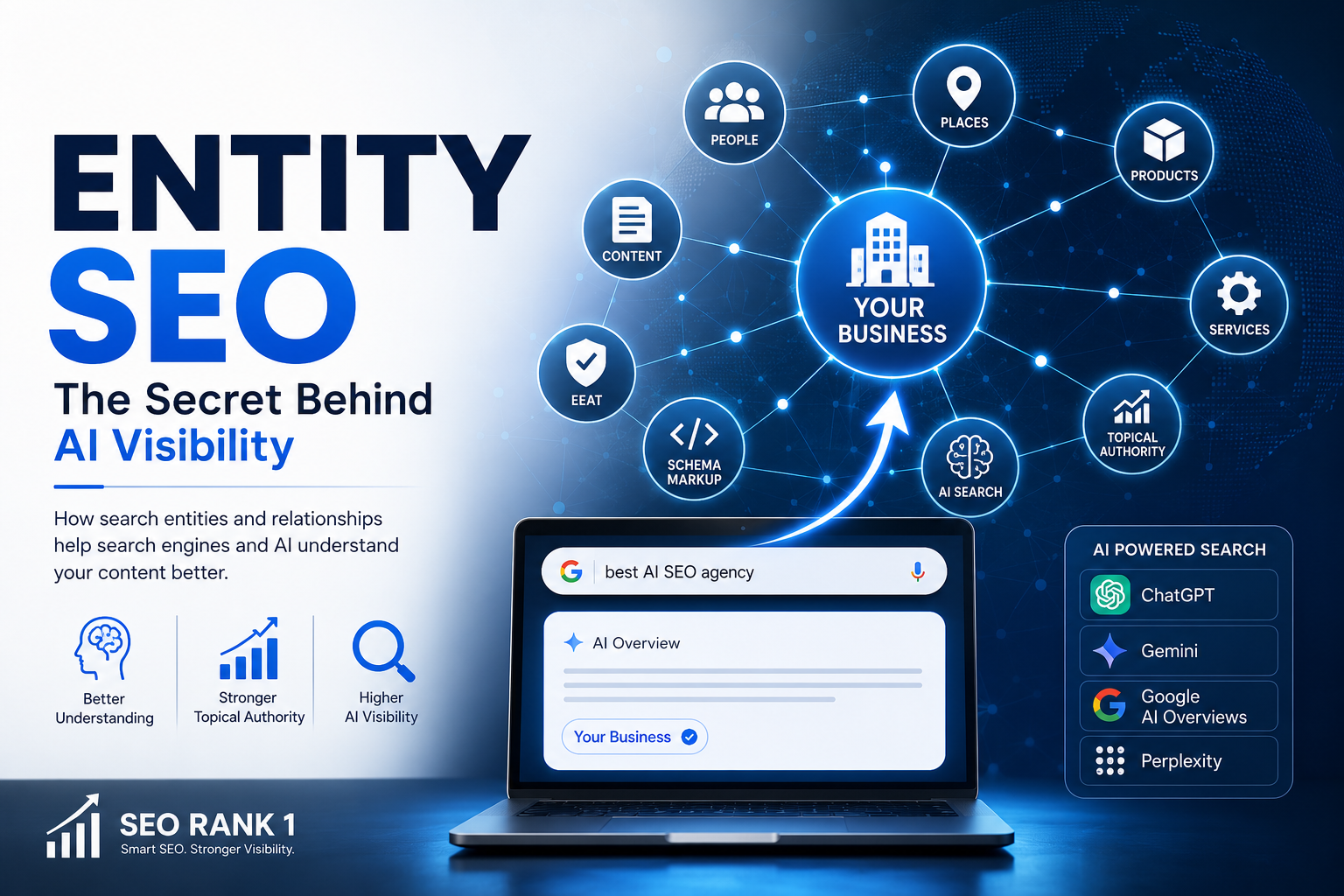
Today, Google and AI-powered search platforms like ChatGPT, Gemini, Google AI Overviews, and Perplexity don’t just analyze keywords they understand entities and the relationships between them. This shift has made Entity SEO one of the most important strategies for improving AI Visibility and staying competitive in the future of search.
Instead of asking, “Which keywords should I rank for?” businesses should also ask, “How can search engines understand who we are, what we do, and why we’re an authority in our industry?”
This guide explains how search entities shape modern SEO, why they are essential for AI Search Optimization, and how they help search engines and AI platforms understand your content more accurately.
What Is Entity SEO?
Entity SEO is the practice of optimizing your website around recognizable people, businesses, places, products, services, and concepts known as search entities rather than relying solely on keywords.
An entity is anything that has a unique identity. For example:
- Apple (the technology company)
- New York City
- ChatGPT
- Search Engine Optimization
- Nike
- Cristiano Ronaldo
Search engines can identify these entities regardless of the words users type into the search bar. This allows them to understand context, relationships, and user intent much better than traditional keyword matching.
Unlike traditional SEO, which focuses primarily on matching keywords, Entity-Based SEO helps search engines connect your website to a broader network of related topics and concepts.
For example, if your website offers SEO services, Google doesn’t only look for the keyword “SEO Agency.” It also evaluates related entities such as technical SEO, content marketing, structured data, backlinks, EEAT, AI Search, and digital marketing to determine your expertise.
This is why Entity Optimization has become a critical part of modern SEO.
Why Entity SEO Matters
Search engines are becoming knowledge engines rather than keyword-matching systems.
Google’s goal is to understand information the same way humans do. Instead of simply identifying repeated keywords, it analyzes relationships between entities, topics, brands, and user intent.
This is especially important as AI-powered search continues to grow.
Platforms like ChatGPT, Google AI Overviews, Gemini, and Perplexity generate answers by understanding concepts not just matching keywords. Websites with strong Entity SEO are more likely to become trusted sources because AI systems can clearly identify what those websites represent.
Strong Entity SEO offers several benefits:
- Improves AI Visibility across AI-powered search platforms.
- Helps search engines better understand your business and expertise.
- Builds stronger Topical Authority within your niche.
- Increases relevance for related search queries.
- Supports long-term AI Search Optimization strategies.
- Improves the overall quality and context of your content.
As search continues to evolve, businesses that focus on entities instead of isolated keywords will have a significant competitive advantage.
Entity SEO vs Traditional Keyword SEO
Traditional SEO and Entity SEO are not competitors they work best together.
Traditional keyword optimization helps search engines understand the words users search for, while Entity-Based SEO helps them understand the meaning behind those words.
| Traditional SEO | Entity SEO |
| Focuses on keywords | Focuses on entities and relationships |
| Matches search terms | Understands context and meaning |
| Optimizes individual pages | Builds overall topical authority |
| Targets rankings | Improves understanding and AI visibility |
| Relies heavily on keyword relevance | Relies on semantic relationships |
For example, if someone searches for “best AI SEO agency,” search engines don’t only analyze the words “AI,” “SEO,” and “agency.” They also evaluate related entities such as AI Search Optimization, Semantic SEO, EEAT, structured data, and digital marketing to determine which websites provide the most authoritative answer.
That’s why combining keyword optimization with Entity Optimization creates a stronger and more future-proof SEO strategy.
How Search Engines Understand Search Entities
Modern search engines use advanced technologies such as Natural Language Processing (NLP), machine learning, and semantic analysis to identify search entities within web content.
Rather than treating every word as an isolated keyword, they analyze how entities relate to one another.
For example, when Google reads an article about Entity SEO, it may recognize related entities including:
- Semantic SEO
- Knowledge Graph
- Schema Markup
- AI Search
- EEAT
- Topical Authority
- Search Intent
The more clearly these relationships are established, the easier it becomes for search engines to understand your content and determine its relevance.
This semantic understanding is one of the main reasons why comprehensive, well-structured content consistently performs better than pages optimized only for exact-match keywords.
How Semantic SEO Supports Entity SEO
Semantic SEO plays a vital role in the success of Entity SEO by helping search engines understand the meaning and relationships behind your content not just the keywords it contains.
Instead of optimizing a page around a single keyword, Semantic SEO focuses on covering a topic comprehensively using related entities, concepts, and user intent. This allows search engines and AI-powered platforms to better understand the context of your content and determine its relevance.
For example, an article about Entity SEO should naturally include related topics such as Knowledge Graph, Entity Optimization, Topical Authority, AI Search, and Structured Data. These semantic connections help search engines recognize your expertise and strengthen your authority on the subject.
By combining Semantic SEO with entity optimization, you create content that is more informative, context-rich, and easier for Google and AI search engines to interpret. This not only improves traditional rankings but also increases your AI Visibility across platforms like ChatGPT, Google AI Overviews, Gemini, and Perplexity.
The Role of the Knowledge Graph
One of Google’s most powerful technologies for understanding entities is the Knowledge Graph.
The Knowledge Graph is a massive database that stores information about millions of people, businesses, organizations, products, locations, and concepts, along with the relationships between them.
When Google understands your business as a recognized entity, it gains greater confidence in your content and can better connect it to relevant search topics.
For example, a trusted SEO agency may be associated with entities such as:
- Technical SEO
- Content Marketing
- Local SEO
- AI Search Optimization
- Semantic SEO
- Digital Marketing
- Website Audits
The stronger these connections become, the easier it is for both Google and AI-powered search engines to understand your expertise.
This is why improving your presence within the Knowledge Graph, strengthening your brand identity, and creating clear relationships between topics are essential parts of a successful Entity SEO Guide and a long-term strategy for increasing AI Visibility.
Entity SEO and AI Visibility
As AI-powered search continues to evolve, Entity SEO has become one of the strongest factors influencing AI Visibility. Unlike traditional search engines that relied heavily on keywords, modern AI platforms understand concepts, relationships, and context before generating answers.
When users ask questions in ChatGPT, Google AI Overviews, Gemini, or Perplexity, these platforms analyze entities rather than simply matching keywords. They look for trusted brands, recognized topics, expert authors, and authoritative websites to generate accurate responses.
By implementing Entity Optimization, you make it easier for AI systems to understand your business, your services, and how they relate to other entities within your industry. The stronger these relationships become, the more likely your website is to be recognized as a trusted source in AI Search.
Entity SEO also supports AI Search Optimization by improving the way AI models interpret your content. Instead of seeing isolated keywords, they understand the complete context of your pages, allowing them to deliver more accurate recommendations to users.
Best Practices for Entity SEO
Building a successful Entity SEO strategy requires more than adding keywords to your pages. The goal is to create a strong digital identity that search engines and AI platforms can easily recognize.
Here are some best practices:
- Build Topical Authority: Create comprehensive content around your niche instead of publishing unrelated articles. Cover your topics from multiple angles to demonstrate expertise.
- Implement Structured Data: Use Schema Markup to provide clear information about your business, services, authors, products, and organization.
- Strengthen Internal Linking: Connect related pages using descriptive anchor text to reinforce relationships between entities and improve website structure.
- Maintain Consistent Brand Information: Ensure your business name, contact details, and company information remain consistent across your website and external platforms.
- Create High-Quality Content: Publish original, accurate, and helpful content that answers users’ questions and demonstrates real expertise.
- Earn Trusted Mentions: Backlinks and brand mentions from reputable websites strengthen your authority and help search engines better understand your business.
- Optimize for Semantic SEO: Use related terms, synonyms, and supporting topics naturally throughout your content instead of relying on repetitive keywords.
By following these practices, you’ll improve both your Entity SEO performance and your long-term AI Visibility.
Common Entity SEO Mistakes
Even experienced marketers often overlook the importance of entity optimization. Avoid these common mistakes:
- Focusing only on keywords instead of entities.
- Publishing thin content with little topical depth.
- Ignoring Schema Markup and structured data.
- Creating weak internal linking between related topics.
- Covering too many unrelated subjects on the same website.
- Using inconsistent brand information across online platforms.
- Neglecting EEAT signals such as author expertise and business credibility.
Avoiding these issues helps search engines better understand your website and strengthens your authority in AI-powered search.
The Future of Entity SEO
As search engines become more intelligent, Entity SEO will continue to play an increasingly important role in digital marketing.
AI-powered search experiences are moving beyond simple keyword matching and focusing on understanding real-world concepts, relationships, and trusted sources. Businesses that invest in Entity-Based SEO, Semantic SEO, and Topical Authority today will be better positioned to succeed as AI Search continues to evolve.
Rather than asking, “Which keywords should I target?” marketers will increasingly ask, “How can I become the most trusted entity in my industry?” That shift represents the future of SEO.
How SEO Rank 1 Can Help You Dominate Zero-Click Searches
At SEO Rank, we specialize in helping businesses adapt to the ever-changing search landscape including the rise of zero-click searches. Our team uses advanced featured snippets optimization, schema markup best practices, and structured data SEO to make your content visible in Google’s most valuable positions. Whether your goal is to appear in People Also Ask SEO boxes, FAQ rich results, or knowledge panels, we craft data-driven strategies tailored to your niche. By analyzing search intent and optimizing your website structure, we help ensure that your brand gets seen even when users don’t click through. With continuous monitoring, competitive analysis, and on-page improvements, SEO Rank helps you maintain authority, visibility, and long-term SEO growth. If you’re ready to turn zero-click searches into an opportunity for brand exposure and credibility, you can contact our experts to guide you every step of the way.
FAQs
What is Entity SEO?
Entity SEO is the process of optimizing your website around identifiable entities such as people, businesses, products, and concepts to help search engines and AI platforms better understand your content and improve its visibility.
How does it improve AI Visibility?
By strengthening the relationships between your content, your brand, and related topics, this approach helps AI-powered search engines understand your expertise and increases the likelihood of your content being referenced in AI-generated answers.
What is the difference between Entity SEO and Keyword SEO?
Keyword SEO focuses on optimizing pages for specific search terms, while Entity SEO focuses on the meaning and relationships behind those terms. Combining both approaches creates a stronger and more effective SEO strategy.
Why is the Knowledge Graph important?
The Knowledge Graph helps search engines understand entities and the connections between them. A strong presence within these relationships improves credibility, topical relevance, and search visibility.
Does it help with AI Search Optimization?
Yes. Entity SEO is a key part of AI Search Optimization because AI-powered search engines rely on entities, context, and semantic relationships to generate accurate answers instead of simply matching keywords.
The future of SEO is no longer centered solely on keywords it’s about building meaningful relationships between entities, topics, and trusted sources.
By investing in Entity SEO, strengthening your Topical Authority, improving Semantic SEO, and implementing effective Entity Optimization, you help both search engines and AI platforms better understand your business. This not only improves traditional rankings but also increases your AI Visibility across platforms like ChatGPT, Google AI Overviews, Gemini, and Perplexity.
As AI Search continues to evolve, businesses that build a strong entity-based presence today will be better equipped to earn trust, attract qualified traffic, and remain competitive in the next generation of search.